Its confirm that the debate on the recent petroleum hike by the government between PKRde facto leader DatukSeriAnwar Ibrahim and Information Minister Datuk Ahmad Shabery Cheek on 15 July 2008 which is organised by Agendadaily.com in DewanBahasadanPustaka in KualaLumpur. It’s going to be an interesting debate to view.
This is an great opportunity for each side to explain and defend their arguments – one side to justify the Government’s decision to raise fuel prices and the other claiming the prices will go down if the Opposition gets into power.
Anwar had recently said that if the Pakatan Rakyat (PR) coalition took over the government, it would reduce fuel prices the very next day, adding that PR would announce the mechanism at the appropriate time and that he would resign if he failed to do so.
Using the US presidential elections debate format, a moderator would be appointed soon while Ahmad Shabery and Anwar would each select a journalist to join in the panel to ask questions. Only 200 people will be invited while our two debaters will be allowed to bring along 50 guests each.
It will be a live telecast on TV 1, TV 3,TV 9 and ASTRO (AWANI and BERNAMA) at 9 p.m. Enjoy the debate!
The operation saw the infamous arrest of 106 persons under the Internal Security Act (ISA) and the revoking of the publishing licenses of two dailies, The Star and the Sin Chew Jit Poh and two weeklies, The Sunday Star and Watan. Operation Lalang carried out on October 27, 1987 by the Malaysian police to crack down on opposition leaders and social activists.
The political developments which brought this second largest ISA swoop in Malaysian history since the May 13 riots were sparked ostensibly by mounting political tensions having strong racial overtones. According to the White Paper explaining the arrests, various groups who had played up "sensitive issues" and thus created "racial tension" in the country had exploited the government's liberal and tolerant attitude. This racial tension made the arrests necessary and further, forced the government to act "swiftly and firmly" to contain the situation.
The sensitive issues were brought on by what appeared innocently enough as Education Ministry appointments of some 100 senior assistants and principals to vernacular Chinese schools. This provoked a storm of protest when it was learnt that those appointed were Chinese whom were not Mandarin-educated.
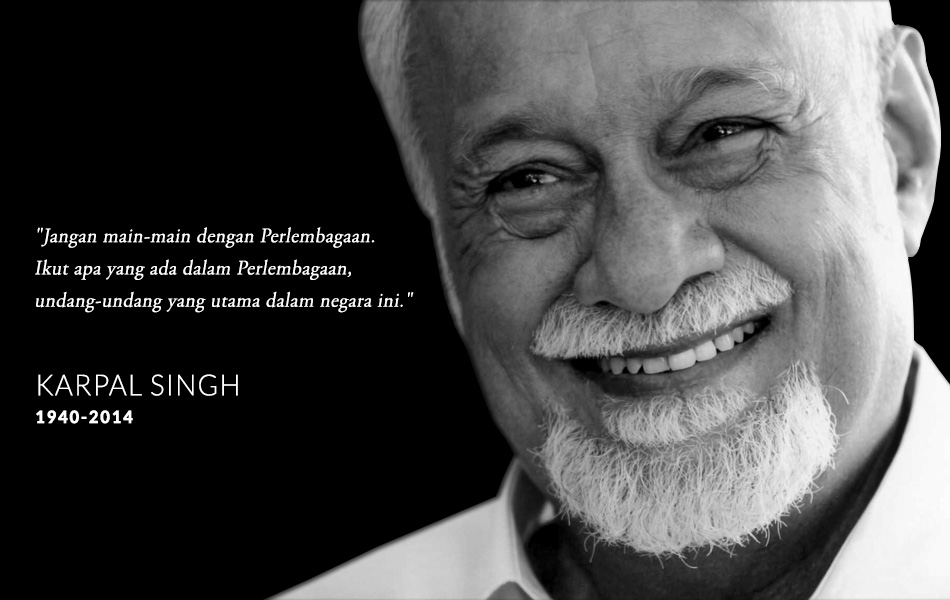
Operation Lalang resulted in the arrest of 106 people under the Internal Security Act. Among the more prominent detainees were opposition leader and DAP Secretary-General Lim Kit Siang, ALIRAN President Chandra Muzaffar, DAP Deputy Chairman Karpal Singh, MCA Vice President and Perak Chief Chan Kit Chee, PAS Youth Chief Halim Arshat, UMNO MP for Pasir Mas Ibrahim Ali, and UMNO Youth Education Chairman Mohamed Fahmi Ibrahim. Other prominent non-political detainees included Dong Jiao Zhong (Chinese Education Associations) Chairman Lim Fong Seng, Publicity Chief of the Civil Rights Committee Kua Kia Soong, and WAO member Irene Xavier. Besides that, there was also another detainee called Hilmy Noor, a Malay Christian, who was accused for "disrupting the Malay culture by being a Christian", while the Federal Constitution of Malaysia defines Malay as someone who is a Muslim, speaks Malay, and practices Malay culture. The detainees were kept at the usual place used for ISA detainees, at KamuntingDetentionCenter.
Although most of the detainees were released either conditionally or unconditionally, 40 were issued detention order of two years. Included were Lim Kit Siang and Karpal Singh plus five other party colleagues, a number of PAS members and many social activists. A categorization of the initially named detainees, numbering 97, gives the following breakdown:
political parties: 37
social movements 23
Individuals: 37
The 1987 Ops Lalang mass ISA detentions was a black day for human rights in Malaysia.
Two natural heritage sites in Malaysia made it to the World Heritage List in December 2000: the GunungMuluNational Park in the State of Sarawak and the KinabaluPark in the State of Sabah.After few years Melaka and Penang highlighted in the World Heritage list.
The inscription of a property on World Heritage List is creating many benefits for Penang and Melaka, and in particular, for local communities.World Heritage Listing develops local and national pride in the property and develops feelings of national responsibility to protect the area.
THE 17th CENTURY DUTCH STADHUYS
The site which is being nominated in Penang is within George Town. Referred to as the historic centre, the site comprises the 18th century town grid close to the waterfront, and the historic multi-cultural neighbourhoods. The site covers approximately 108 hectares. In Melaka the site which is being nominated in represents the historic core which includes the ruins of the 16th century fortress town and the neighbouring historic and traditional settlements. The site covers approximately 42 hectares.
ST.PAUL'S HILL,MALACCA
While this listing will no doubt boost economic activity in the inner city and expand the economy,
I urge federal government and state government will join effort to make full use of this precious prospect, political parties must always bear in mind that peoples and nation’s interest comes before party’s ideology especially Penang state. The state lead by nation’s opposition party, allocation of financial must be given without fear or favour by federal government and at the same time state government must welcome the plan and strategies that introduce by federal government.
FORT CORNWALLIS-THE FIRST BRITISH SETTLEMENT ON PENANG
Malaysia intends to transform its educational system, in line with and in the support of the nations drive to fulfill vision 2020. The smart school project is one of the main development to support Multimedia Super Corridor (MSC).
To be a smart school, consider the following challenges:
Leadership is the key ingredient; school management must be committed to education system on the idea of SmartSchool.
The technological infrastructure is more than enough to replace the traditional way of teaching and learning.
Schools are supposed to have enough technical expertise to maintain the ICT infrastructure.
Teachers need more training on ICT programs than the students. It’s important to ensure teachers capability to deliver their curriculum. ICT facilities accessible to the school community even when the school is not in session, thus students able to explore their studies at all the time.
Educators create enough digital contents for used in new learning environment. At the same time, connectivity stable enough to support information anytime and anywhere so that teaching and learning is not just confine to the four walls of the classroom. It must be a teaching and learning community that extends beyond the traditional school walls.
At the same time, it’s not all about equipments. China and India students have some of the worst equipment I have ever seen but their abilities are just amazing. Frankly, I see a lot of poor rural parents know the importance of education. What they lack is proper educational influence and role-model. They are surrounded by poorness in everything and expectation of them. So with the first-class equipment there are no reasons for students to be unsuccessful in their studies. I’m sure I will do my part as a future teacher by accept the teachers challenges to help creating the smart schools. The teachers must fully utilise the Technology Infrastructure and capable of
delivering to the students in best method.
It won't take too long before the number of students in private colleges and universities (IPTS) in Malaysia outnumbers those in the public universities. The ratio is approaching 1:1, according to a recent Star report. What are some of the implications? What are some of the challenges? Is it creating a huge impact on national education standard? How about job opportunities?
With as many students entering IPTS compared to the IPTA importance will only grow and will have a big impact on the job generate potential in the education sector the skill levels of the work force and the research activities in our universities.
There are another layer of IPTS who don't have research aspirations but will be known for offering good facilities, courses and teaching. In addition, I suspect that there will also be some specialized IPTS which focus on certain types of courses – design (LimKokWing) or IT (Informatics). And then there will be a scattering of smaller IPTS which offer 'value for money' courses. These colleges have been growing rapidly since decades ago.
There will be a different in the quality and reputation of private colleges and universities. In fact some of this is already happening. There will emerge a handful of IPTS which will challenge the IPTA as research universities. SunwayMonash and Nottingham are obvious candidates. There will be other 'home grown' IPTS which will want to or be pushed to the direction of being research universities. This is another good move by private colleges and universities to competing each other in various sectors.
But there are also many concern associated with the rapid development of the IPTS, including:Generally, I think the quality of lecturers must be equal standard with IPTA. The types of courses being offered are commercially viable. The growing number of foreign students is the problems associated with this are above the limit.
The development of the IPTS has more positives than negatives, in my opinion. It provides another avenue of job creation for the country, it gives different options to Malaysians who want to earn a degree, it earns foreign exchange for the country and it can contribute towards human capital development as nations agenda that we searching for.
Some 70% of public universities and institutes of higher learning graduates in the country are unemployed. This is in contrast with 26% for private institutions of higher learning and 34% for foreign graduates. I think even the most cynical amongst us out there would have been shaken by such a staggering number of unemployed graduates. I mean how can more than half of our graduates be unemployed?
I suspect that some incompetent statistician somewhere took the total number of unemployed graduates in the country who could have graduated in different years and divided the number by the number of tertiary education students in a year to obtain the silly percentage.If however, the "70%" statistic is indeed true, then I think we might as well shut down half of our public universities.What was more interesting however is the additional breakdown of unemployed graduate numbers by universities provided by the Ministry. Note that the following breakdown refers only to the 20,217 who have registered themselves with the Ministry of Human Resources, and does not include those who haven't bothered with the Ministry.
It is most interesting to note that Universiti Teknologi Mara (UiTM) contributes by far the most number of unemployed graduates amongst all the universities in Malaysia. The number of unemployed produced (3,278) is more than double the next highest university, Universiti Utara Malaysia (UUM) (1,532). To put it into context, it is hence extremely laughable that UiTM as recently years ago, declared itself to be a "world class university".
Singapore offers S$1 million (RM2.3 million) for an Olympic gold while South Korea US$200,000 (RM662, 000). How much for Malaysian athletes?
RM1 million incentives is a great motivator to our athletes. To win a gold medal is not easy because the competition is getting tougher. We can see that from one Olympics to another, the standard is increasing. We should therefore set a higher target, and provide a more attractive incentive, RM1 million for gold RM300, 000 incentive to silver medallists and RM100, 000 to those who won the bronze. Reward was appropriate as the Olympics was an international event and held only once in four years.
We have never won a gold medal in the Olympics, badminton seems to be our best prospect, but we should not set high hopes as in the past, it was only manage to contribute silver and bronze medal each. Psychological strength is one of the aspect that separate winners fro each other. Our athletes are of world standard in certain sports but whether they win or lose will depend on their mental strength.
I don't think such incentives are wasting our money. Let's do some calculation here: What are the probabilities that any of our athletes could win any medal at the Olympics? Winning an Olympics medal is something special that not everyone can achieve. Nowadays, sports all over the world have become profitable events. All top athletes get paid lucratively. The pride of our country is at stake. As long as our athletes confident that they can make it, then the gold medals are achievable.
WATER CANNON AND TEAR GAS USED IN THE HINDRAF PEACEFUL ASSEMBLY IN BATU CAVES
More than 40,000 protested on 10 November and about 50,000 went out to protest on 25 November 2007. It was a huge amount t of protesters in Malaysia’s history after almost 10 years. A total of approximately 100 000 Malaysians who have taken o the streets in peaceful and non-violence protests, not counting the smaller protest against fuel price hikes, toll rates hikes, judiciary reforms and various issues regarding ethnics.
Hundreds are netted by police, the larger portions that are released after some hours of detention. What goes on during those hours of detention, only those who have been in can tell. No doubt, police will try to weed out the ‘ring leaders’. Yet all the mainstream media reports, however biased, there is noticeably a common denominator-it is the police who started firing tear gas and used water cannon to spray and disperse they unarmed crowd.
The police alleged that they have used minimum force against protestors, but using machines like water cannons and tear gas is not a minimum force towards the peaceful protestors. It could be construed as an unjustified amount of force against people who were in no way being violent in defending themselves. Television footage showed that some even not defending them.
Those who went out into the streets to openly express their frustration with the breakdown of law and order, the denial of constitution and human rights, the increasing deterioration and distortion of electoral system, and the rising living cost in the absence of comparative increases in incomes, were told that they were being “un-Malaysian”.
When a Malaysian singer Salamiah Hassan was asked what she would like to reborn if given the second opportunity her reply was, "I would choose to born as Mahatma Gandhi because he is peace loving person." What a noble choice of the singer. I really respected her answer. The almost same question asked to Tun Dr Mahathir
Compare this to Mahathir’s choice of an idol. Not for him Mahatma Gandhi, Lincoln, or Mandela. He was on record as having said that his idol is Bollywood star Sharukh Khan. SK’s song and dance consists mainly of chasing some buxom damsel round flower beds and trees in a park. Wonder if Dr M envies SK. He should never even imagine himself chasing a damsel round trees and playing hide and seek, given his heart condition. It would indeed be life threatening.
SK is one of 150 million Muslims, happy, peace and prosperous in secular nation India. Wonder Dr M envies freedom that SK enjoys in India. Sharukh Khan’s wife, Gauri is a Hindu and his two children are brought up as Hindus. Possibly, Dr M in his heart, hope that one day Malaysia will be liberal, cultured and civilized enough to grant its citizens free choice of religion as guaranteed in Malaysian Constitution.
When SK was asked about the possibility of his entering politics world, he replied, “I am not interested in selfless work.” Perhaps, after all, SK and Dr M have something common. Think about it!
We are watching too much TV. We waste our precious time by watching many channels that broadcast a variety of propaganda, self dreams and illusions. Bombarded with thousands of images daily as they sit passively in front of the television set, TV is the mother of inner battles in all human beings. It is slowly killing the mental capacity of our future generation to sustain reading. An uncritical mind is a productive ground for mental colonisation. Print and broadcast media are powerful tools of propaganda. While many Malaysian parents struggle to have their children read well so that they may not be continuously confused and brain dead, TV is producing more and more programmes that making children have four eyes.
Bollywood is an industry. Malaysians especially have been conditioned to love Hindustani movies because they have been around since the early days. Many Malaysians are of the south Indian stock, and therefore Bollywood helps Malaysians get stoned glued to such programmes in the modern age.
Finally, I would like to state that the live telecast of the Malaysian parliamentary debates is good for the nation. Political accountability can contribute to higher levels of civic consciousness. Our elected representatives are presenting their credibility by debating on the major issues . It will be a good way to educate Malaysians, especially the younger generation of the political process, participatory democracy, ethics of politics, intellect, and of powerful expressions. I hope this is the first step to the promising world of high-quality TV programmes.
 Its confirm that the debate on the recent petroleum hike by the government between PKR de facto leader Datuk Seri Anwar Ibrahim and Information Minister Datuk Ahmad Shabery Cheek on 15 July 2008 which is organised by Agendadaily.com in Dewan Bahasa dan Pustaka in Kuala Lumpur. It’s going to be an interesting debate to view.